
Resources
Blog
Insights on events, technology, and the future of gathering
Latest articles
Insights on events, technology, and the future of gathering
Quick answer: Event gamification adds game-like elements - points, challenges, and rewards - to keep attendees engaged throughout your event. The top examples are trivia, scavenger hunts, photo contests, bingo, engagement leaderboards, team competitions, personalized badges or trophies, public shout-outs, and ice breakers, all easy to run with an event platform like Canapii.
Every event organizer hopes that their event’s content is fascinating enough on its own to capture and hold participants’ attention. In reality, though, you might need a dose of something extra to keep attendees engaged and energized, especially if your event is longer than a day. Event gamification is a reliable and surprisingly easy way to keep your attendees interested and boost your event outcomes.
Event gamification is a broad term that refers to incorporating game-like processes and elements into your event to make it more engaging and to motivate attendees to keep interacting. It can involve prizes, but it doesn’t have to, because even the presence of a challenge can boost your attendees’ interest and engagement. If you want to incorporate gamification into your next event, the nine examples below show how to use the strategy smoothly.
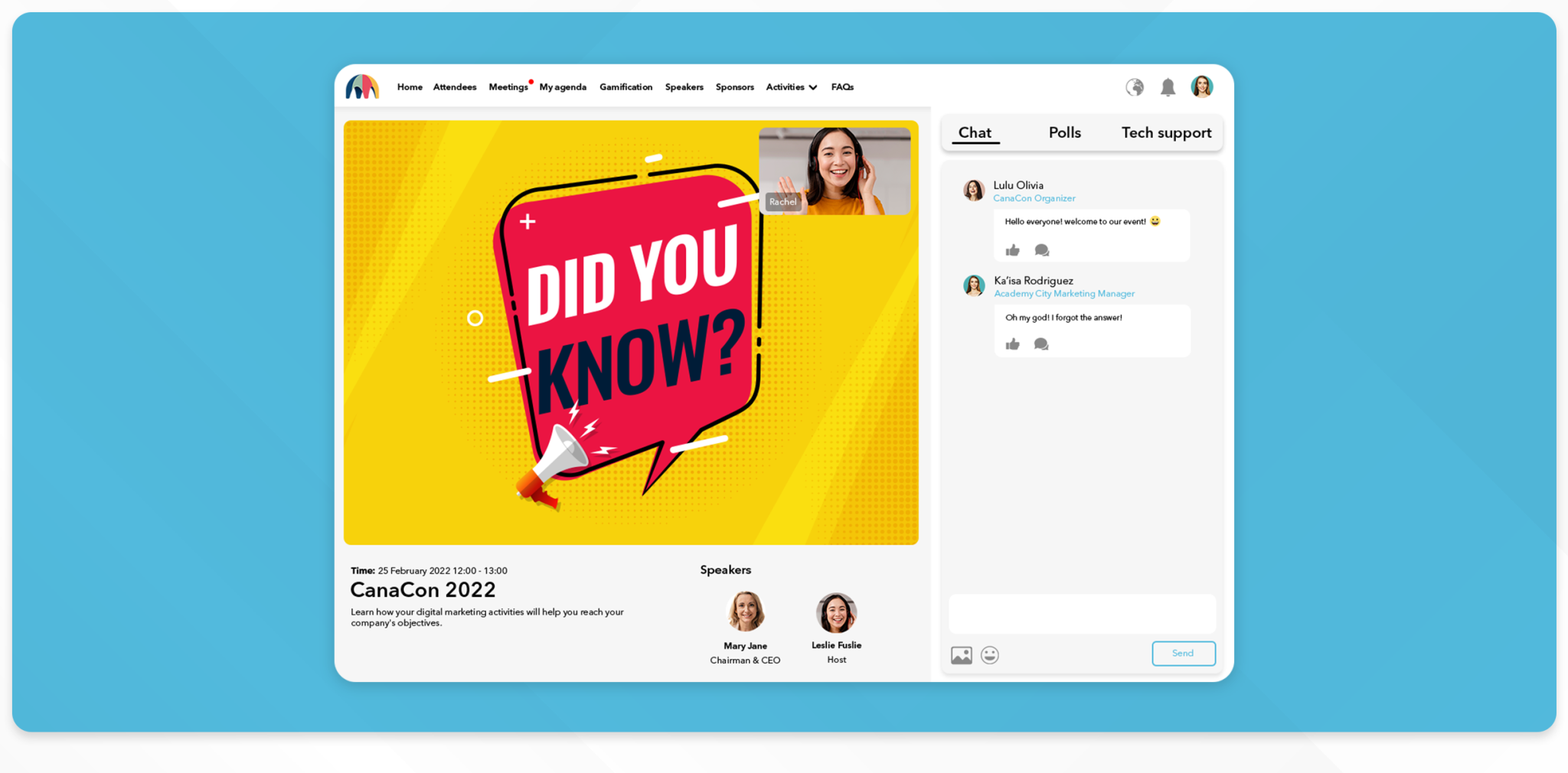
People love to test their knowledge, and a trivia contest puts that instinct to work for your event. There are a few ways to run it: session leaders can start each session with a trivia question and let attendees submit their answers, or you can send out trivia questions about the information covered in sessions to keep attendees on their toes. Either way, you keep a running tally of each attendee’s score for their correct answers throughout the event.
In a scavenger hunt, you give participants a list of tasks to complete at some point during the event. You might challenge them to find out the first name of at least five vendors, for example, or to get a picture with a presenter. Attendees who complete all the tasks on the list, or a certain percentage of them, earn a prize.
A photo contest is a similar challenge to a scavenger hunt but centred solely around photos. You might challenge attendees to get a picture with two attendees who are from countries that aren’t their own, get photos with a certain number of vendors, and get a photo with two people who have the same job title they do, for example.
Bingo turns participation tasks into a card game. Before your event, come up with a variety of tasks and put each one inside the square of a bingo card. You can even use software to randomly mix up where each task sits so that every participant’s card is different. Throughout the event, participants mark off each square as they complete the task in it, and when they mark off squares in the right configurations, they’ve won a bingo.
An engagement leaderboard turns every interaction at your event into points. There are plenty of ways for people to participate - answering questions during sessions, signing up for vendors’ mailing lists, joining interactive activities, and so on - and you can assign points to each of these actions. Throughout the event, you display the running tally on a leaderboard, sparking competition and driving attendees to earn more points.
Teamwork makes the dream work, as they say. Foster networking and interaction by putting your attendees into teams and pooling the attendees’ participation points together for their team. This gives them the drive to motivate each other to be more engaged and interactive.
Collecting a “set” of something can be an exciting motivator for your attendees, and you can put that to use by creating personalized badges or trophies that attendees can earn for engaging and participating in certain ways. When attendees collect all or a certain number of badges, you can reward them with a prize or public recognition.
You don’t need material prizes to motivate people; public shout-outs alone, and the pride they bring, can be enough to drive attendees to be more active in your event. You can create a system that awards points throughout the event for active participation and announce the winners at the end, or you could give event staff the opportunity to submit shout-outs for any particularly active participants they see.
Part of the benefit of an event, whether it’s virtual or in person, is networking. To encourage participants to network more actively, try setting up ice breaker games. For example, you can hand out a sheet of prompts such as “Find someone who has a Taurus astrological sign”, “Find someone who has a hobby that you haven’t tried”, or “Find someone who has traveled at least 100 miles to be here”.
Event gamification is the use of game-like elements - points, challenges, rewards, and recognition - within an event to make it more engaging and to motivate attendees to keep interacting with content, sponsors, and each other.
No. Prizes help, but even the presence of a challenge can boost attendees’ interest and engagement. Public recognition, such as a shout-out or a spot at the top of a leaderboard, is often motivation enough.
Yes. Trivia, engagement leaderboards, badges, and public shout-outs all run digitally, and ice breaker prompts work just as well over event chat and networking tools as they do on a venue floor.
An engagement leaderboard is the simplest starting point, because event software like Canapii can award points automatically for actions attendees already take, such as answering questions, joining sessions, and voting in live polls.
Event gamification can make your event tremendously more successful, and it doesn’t have to be difficult or expensive with the right platform. Canapii has gamification built in and has powered 2,000+ events for 300,000+ attendees across 45+ countries - get a demo to see how it works.