
Resources
Blog
Insights on events, technology, and the future of gathering
Latest articles
Insights on events, technology, and the future of gathering
Quick answer: A post-event survey is a questionnaire sent to attendees, sponsors, exhibitors, and speakers after an event to capture honest feedback. Send it by email, your event app, social media, or your website, mix different question types, and measure the results - the answers tell you exactly what to improve at your next event.
Have you ever hosted an event you thought went really well, only to find out later that a colleague had a completely different perspective? That gap is exactly why gathering feedback from as many participants as possible matters, especially if you want to improve your future events. This guide covers how to run a post-event survey for in-person events such as conferences, trade shows, and exhibitions - with 25 example questions you can copy. And remember that collecting responses is only half the job: measuring the survey results is what turns them into data-driven insight about your event’s success.
A post-event survey is a questionnaire designed to capture feedback from the people involved in your event. Questions can be multiple choice or open-ended, and surveys can be sent before, during, or after the event - usually digitally, so respondents can complete them from anywhere. Send them to everyone who was involved:
Surveys help you figure out what your audience actually wants - whether that is attracting more sponsors, making virtual events better, or simply making sure people are having a great time.
Because feedback, whether good or bad, shows you what worked and what did not. A post-event survey is the perfect opportunity to get honest input from attendees, volunteers, speakers, and staff - and that information is worth its weight in gold. Use it to make future events even better, and to show your community that their opinions genuinely count.

Use more than one distribution channel if you want to maximize responses. These five options work well, alone or combined:
Email reaches almost everyone, since nearly every attendee registers with an address. Make sure your list is clean and covers every attendee before sending feedback requests, so the responses reflect your whole audience.
Promoting the survey on your event’s social pages - Facebook, Twitter, and LinkedIn - extends its reach and catches attendees who missed the initial email.
An attendee app lets you send push notifications reminding people to complete the survey, keeping the conversation going while the experience is still fresh in their minds.
If your event has a landing page, or the survey is integrated with your event software, hosting the post-event feedback form on your website is a convenient option.
Event apps let you build the survey inside the same tool you plan the event with: enter your questions, send the survey link to your guests, and check the results later in one place.
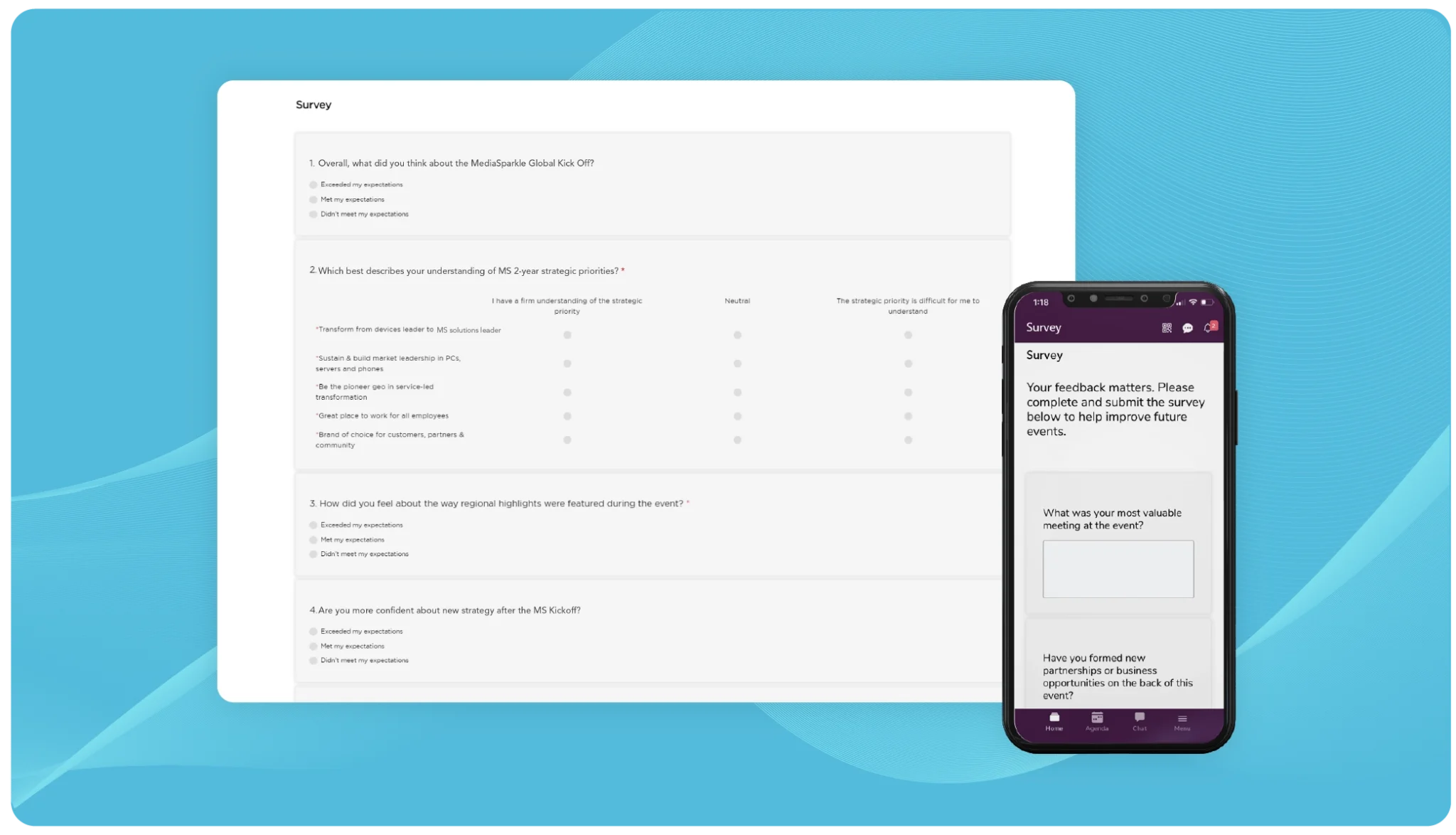
Use a mix of six question types - open-ended, multiple choice, ordinal scale, interval scale, ratio scale, and yes/no - chosen to match the kind of feedback you need. It is not as complicated as it sounds: each type has a specific purpose, and using them appropriately ensures you get all the feedback you need.
Open-ended questions surface detailed opinions on sessions, speakers, and networking opportunities, along with suggestions such as better signage, more food options, or greater diversity and inclusivity. Give respondents enough space to answer, especially if your event is virtual. Example: What did you like most about the event, and what could be improved for next time?
Multiple choice questions sort respondents into clear categories. If attendees are choosing a favorite session and there were only four, limit the options to those four. Example: Which session did you find most valuable at the event? (Select one)
A) Keynote speaker
B) Panel discussion
C) Networking sessions
D) Workshops
Ordinal scale questions ask respondents to prioritize items or pick from an ordered list, which is useful for finding the relative importance of each item. Establish a clear numerical scale, such as 5 being the highest and 1 the lowest. Example: On a scale of 1 to 5, how would you rate the overall organization of the event?
1 – Poorly organized
2 – Somewhat poorly organized
3 – Neutral
4 – Well organized
5 – Very well organized
Interval scale questions let attendees rate an aspect of the event on a scale with uniform steps, covering agreement, likelihood, or satisfaction - from “very unsatisfied” to “very satisfied”, for instance. Example: How would you rate the quality of the keynote speaker?
Very poor
Poor
Satisfactory
Good
Excellent
Ratio scale questions ask for a quantifiable answer with a true zero point - think income, age, or hours worked - and are usually presented as ranges that can still be analyzed as ratio responses. Example: On average, how many hours per week do you spend in meetings with teams or clients?
0–3 hours
3–5 hours
5–7 hours
More than 7 hours
Yes/no questions are simple and unambiguous, which makes the results easy to analyze and interpret. Examples:
Did you attend the event?
Was the event well-organized?
Did you find the event informative?
Did you find the event location convenient?
Was the event worth your time?
Did the event live up to your expectations?
These five questions work for any event format and give you a baseline read on satisfaction. Begin with general questions and become more specific towards the end of the survey.
A simple starting point that shows how the event performed overall and whether it met expectations. It also sets a baseline you can compare against future editions.
This invites specific feedback on the negatives, from logistics to content. Not every response will be actionable, but offering the opportunity shows a real commitment to improving the event experience.
This uncovers how enthusiastic participants are about your events. Compare the responses with how many attendees actually return the following year - if the numbers diverge, evaluate what needs to change.
This gathers concrete improvement ideas and shows attendees their opinions are valued, which builds loyalty and encourages them to come back.
This identifies which marketing channels are proving effective and which areas need improvement.
This tells you whether the schedule allowed enough interaction, or whether future agendas need more Q&A time built in.
This shows your mix of first-timers and returners. Many first-timers may call for adjusted marketing and clearer information; many returners means focusing on fresh value to keep them interested.
This highlights the strongest parts of your program, so you know exactly what to protect and expand at the next event.
This rates your networking sessions directly, helping you judge whether they are effective and worth the investment.
A quick proxy for overall satisfaction: a high likelihood of recommending the event signals a positive experience, while a low one points to areas for improvement.
This gauges the level of help and support your event crew provided, and highlights where exhibitor assistance could improve. Variants include “To what extent did the event staff meet your needs?”
Answered on a 1–5 scale or as a simple yes/no, this tells you whether exhibitors found enough value to come back - and whether similar events are worth hosting again.
Success means different things depending on each exhibitor’s purpose and goals, so the answers reveal how well the event served them and where to improve.
Lead generation is often the main reason exhibitors attend, so this question directly measures whether the event delivered on its core promise - and whether changes are needed next time.
An open invitation for ideas. Review the responses carefully, identify common themes, and prioritize the changes that come up most often.
This asks whether the sponsorship paid off in business leads, brand awareness, or other objectives - essential feedback for keeping sponsors on board for future events.
This shows whether your event is effective at attracting and retaining sponsors, and hints at what you may need to change to win more sponsorship.
Sponsors return when the audience matches their target market. If relevance scores low, expect them to look for events that align better - variants include “Did the event attract attendees who are potential customers for your business?”
This evaluates how well you prepared your sponsors. Follow up personally on any negative answer: it makes sponsors feel heard and gives you actionable detail for improving your approach.
Sponsors exchange financial support for branding and other benefits, so this invites suggestions on visibility and networking that keep the partnership mutually beneficial.
This covers the schedule, audience demographics, and location details a speaker needs. Gaps here directly affect presentation quality, networking, and lead generation.
The event venue and equipment can make or break a keynote, so this feedback helps future events meet speakers’ needs and deliver a positive experience for attendees.
Speakers are VIPs you want to impress. Prioritizing their needs fosters positive, lasting relationships and keeps them participating in future events.
Speakers are usually well connected in their professional communities, and a recommendation from someone who has already presented makes recruiting next year’s presenters far easier.
This helps you tailor future events to your speakers’ requirements. Since speakers are crucial to any event, a favorable speaker experience ultimately benefits everyone involved.
A questionnaire sent after an event to capture feedback from attendees, sponsors, exhibitors, speakers, and staff, using multiple choice, scale, or open-ended questions.
As soon as possible after the event ends, while the experience is still fresh in participants’ minds. Push notifications from an attendee app and a follow-up email work well as reminders.
Everyone involved: attendees, sponsors, exhibitors, speakers, volunteers, and event staff. Each group has a unique perspective that improves a different aspect of the event.
A mix of open-ended, multiple choice, ordinal, interval, ratio, and yes/no questions. Start general, get more specific, and match each question type to the feedback you need.
Distribute it across several channels - email, social media, your website, and your event app - and keep the survey short and easy to complete.
Canapii lets you create, send, and analyze post-event surveys inside the same platform you run your event on - trusted for 2,000+ events across 45+ countries since 2020. Reach out to schedule a demo.